
Complete Classification of LED Transparent Screens
LED transparent screen is a new type of display device built with hollow structure, high-transparency substrate and advanced packaging technology. It features high-definition dynamic display and excellent light transmission, which allows it to perfectly integrate with architectural and commercial spaces without blocking daylight or visibility. It is widely used in commercial shop windows, building curtain walls, exhibition halls, cultural tourism stages and other scenarios. There are many types of LED transparent screens with different craftsmanship on the market, making it easy for buyers to confuse product models and application suitability. This article comprehensively classifies LED transparent screens from three core dimensions: structural form, luminous mode and usage environment. It clearly explains the core differences, advantages, disadvantages and applicable scenarios of each type, providing professional references for product selection, purchasing and engineering implementation.
- 11. Classification by Structural Form
- 1.11.1 Rigid Transparent Screen
- 1.1.11.1.1 LED Grid Screen
- 1.1.21.1.2 Hard Strip Transparent Screen
- 1.1.31.1.3 Photoelectric Glass Screen
- 1.21.2 Flexible Transparent Screen
- 1.2.11.2.1 LED Film Screen
- 1.2.21.2.2 Crystal Film Screen
- 1.2.31.2.3 Holographic Mesh Transparent Screen
- 22. Classification by Luminous Mode
- 2.12.1 Front-emitting Transparent Screen
- 2.22.2 Side-emitting Transparent Screen
- 33. Classification by Usage Environment
- 3.13.1 Indoor LED Transparent Screen
- 3.23.2 Semi-outdoor LED Transparent Screen
- 3.33.3 Outdoor LED Transparent Screen
- 44. Core Selection Guide
- 5FAQs
1. Classification by Structural Form
According to flexibility and installation structure, LED transparent screens are divided into rigid transparent screens and flexible transparent screens. These two categories cover the most widely used products in the industry with clear positioning and market differentiation.
1.1 Rigid Transparent Screen
Rigid transparent screens adopt fixed and stable structures without bending deformation. They feature high stability and strong load-bearing capacity, ideal for long-term fixed installation in large outdoor projects and standard indoor commercial scenarios. They are mainly divided into three types:
1.1.1 LED Grid Screen
The LED grid screen is assembled with aluminum alloy light strips, adopting a fully hollow grid structure without back panels. It is a professional outdoor transparent display solution. With a light transmittance of 60%–90%, it offers extremely low wind resistance and excellent heat dissipation. It reaches IP65 waterproof and dustproof grade, capable of resisting strong wind, rain and extreme temperatures. Common pixel pitches include P7.82, P10.4 and P15.6, suitable for medium and long-distance viewing.
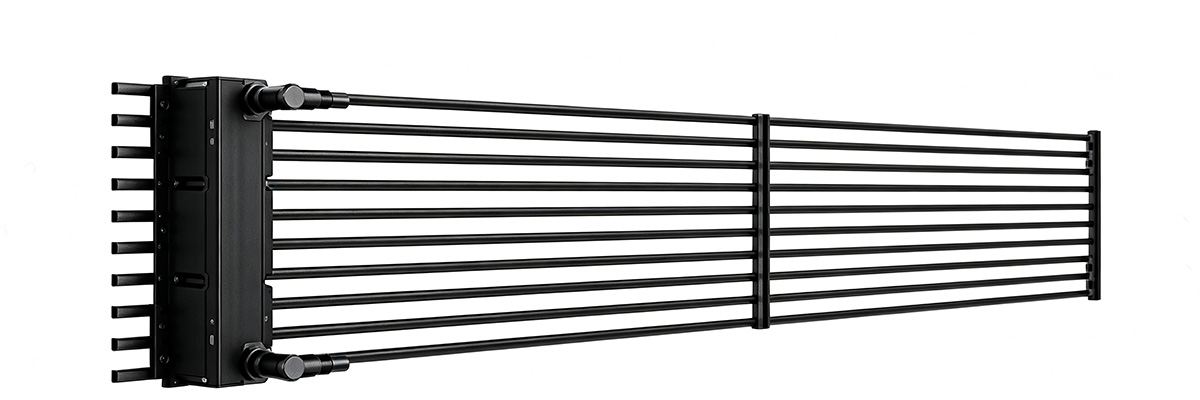
Advantages: cost-effective, windproof, waterproof, lightweight installation, ultra-low wind resistance, perfect for super-large curtain wall projects.
Disadvantages: low pixel density with obvious particle sense at close viewing distance.
Application Scenarios: urban building exterior walls, sky curtain lighting, outdoor landmark advertising, cultural tourism lighting projects, high-rise building curtain wall renovation.
1.1.2 Hard Strip Transparent Screen
As a classic indoor transparent LED screen, hard strip transparent screen adopts integrated rigid PCB modules with neat structure and uniform display performance. Its light transmittance ranges from 40% to 60%. It supports fine pixel pitches such as P2.97, P3.91 and P7.82, delivering clearer image quality than conventional grid screens.
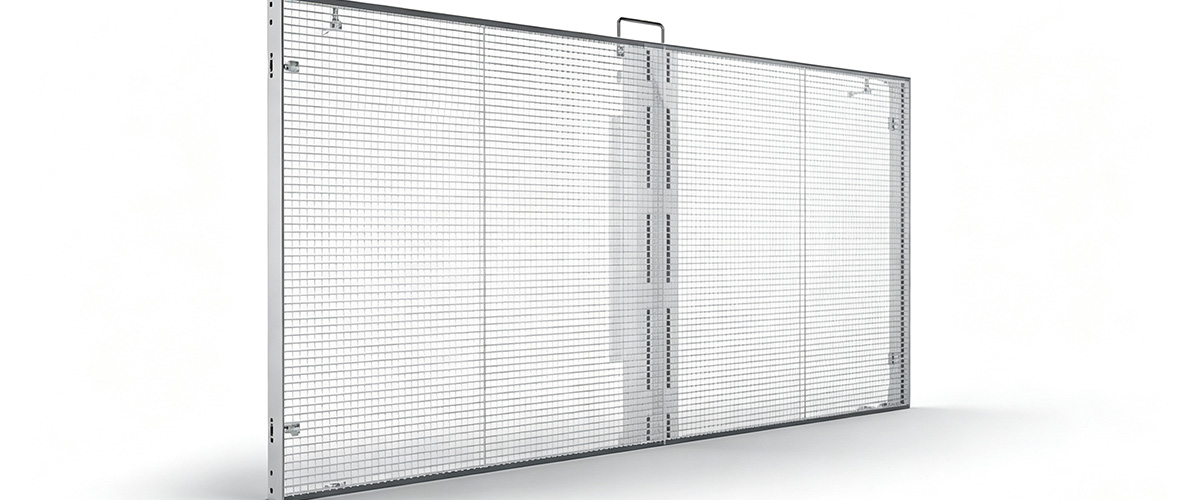
Advantages: clear display, uniform color performance, mature technology, easy maintenance, high cost performance.
Disadvantages: medium light transmittance, unable to support special-shaped curved modeling.
Application Scenarios: shopping mall glass windows, brand store partitions, enterprise exhibition halls, conference room glass curtain walls.
1.1.3 Photoelectric Glass Screen
The photoelectric glass screen is a customized integrated product, with LED beads professionally encapsulated inside double-layer laminated glass. It perfectly combines display function and glass safety performance, achieving 50%–75% light transmittance. It is explosion-proof, sound-insulating, stable and aesthetic with no exposed wires.
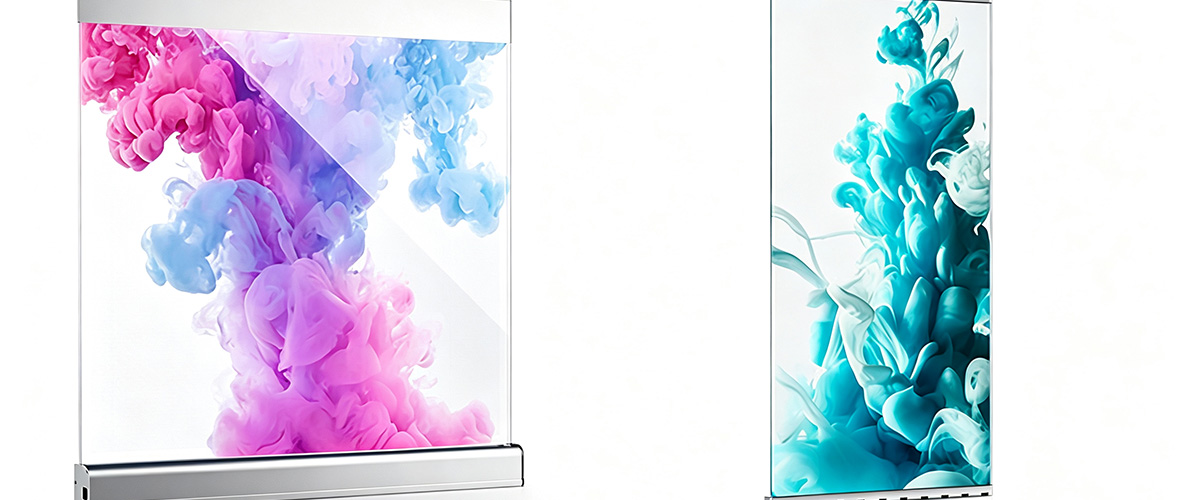
Advantages: high safety, integrated appearance, invisible display effect, suitable for high-end decoration scenarios.
Disadvantages: non-detachable, high maintenance cost, long customization cycle.
Application Scenarios: office building glass partitions, shopping mall guardrails, elevator glass, high-end hotel decorative curtain walls.
1.2 Flexible Transparent Screen
Flexible transparent screens are made of high-transparency flexible substrates, featuring ultra-thin, bendable and cuttable characteristics. They adapt to special-shaped curved spaces and support creative and personalized display solutions, including three mainstream types:
1.2.1 LED Film Screen
With an ultra-thin thickness of only 1–3mm, the LED adhesive film screen comes with self-adhesive backing, which can be directly pasted on the glass surface without steel frame installation. It is ultra-lightweight with 70%–85% light transmittance, supporting slight bending and free size cutting.
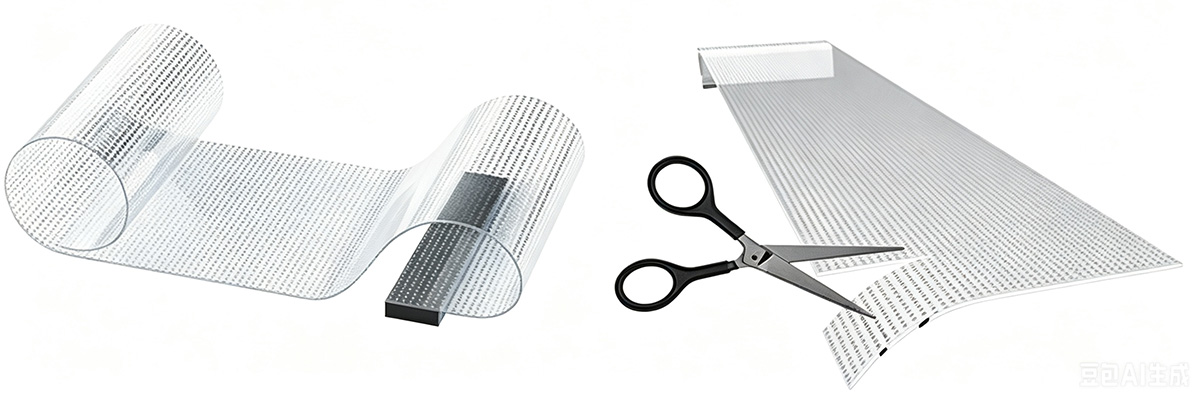
Advantages: simple installation, no damage to glass, excellent invisible effect, ultra-light weight, compatible with various flat glass.
Disadvantages: only supports slight bending, not suitable for large radian curved surfaces.
Application Scenarios: 4S shop glass windows, street store glass, office building floor-to-ceiling windows, temporary exhibition displays.
1.2.2 Crystal Film Screen
The high-end crystal film screen adopts fully transparent flexible film substrate, supporting arbitrary curling and large-radian bending for cylindrical, arc and spherical special-shaped structures. Its light transmittance reaches 80%–95%, achieving an almost invisible effect after screen shutdown with top-level permeability.
Advantages: ultra-high light transmittance, strong special-shaped adaptability, delicate image quality, high appearance value.
Disadvantages: relatively high cost and strict installation process requirements.
Application Scenarios: luxury brand exhibition halls, shopping mall cylindrical columns, special-shaped arc glass curtain walls, immersive art exhibition spaces.
1.2.3 Holographic Mesh Transparent Screen
Adopting ultra-fine mesh flexible circuit design, the holographic transparent screen features sparsely arranged lamp beads, presenting an almost invisible effect from a long distance. It supports 3D floating image display with excellent virtual-reality fusion effect and arbitrary shape cutting.
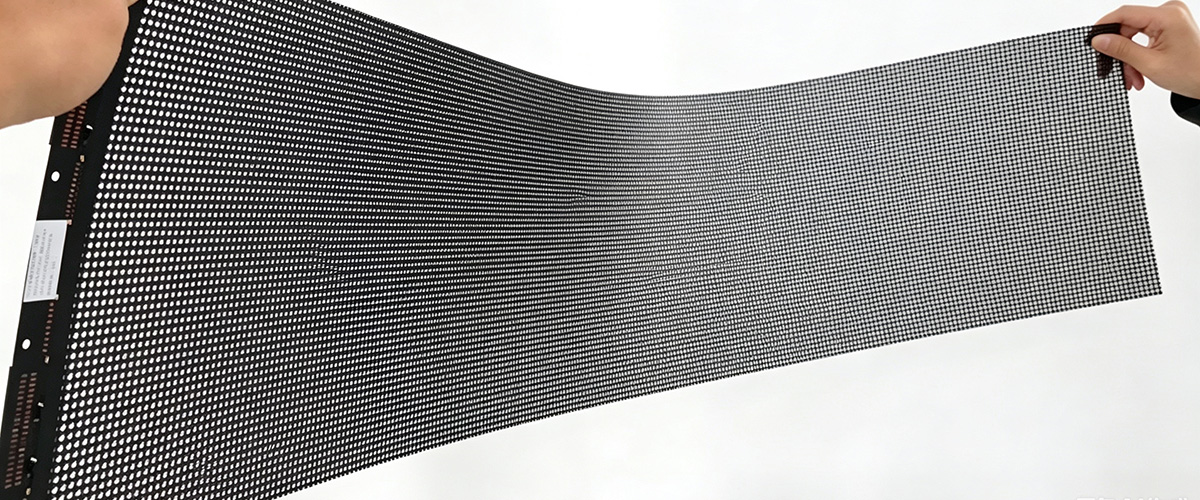
Advantages: ultimate invisible effect, strong immersive experience, perfect for creative stage art.
Disadvantages: limited brightness, only applicable for indoor low-light scenarios.
Application Scenarios: stage performances, concert backgrounds, museum immersive exhibitions, Internet celebrity check-in spaces.
2. Classification by Luminous Mode
2.1 Front-emitting Transparent Screen
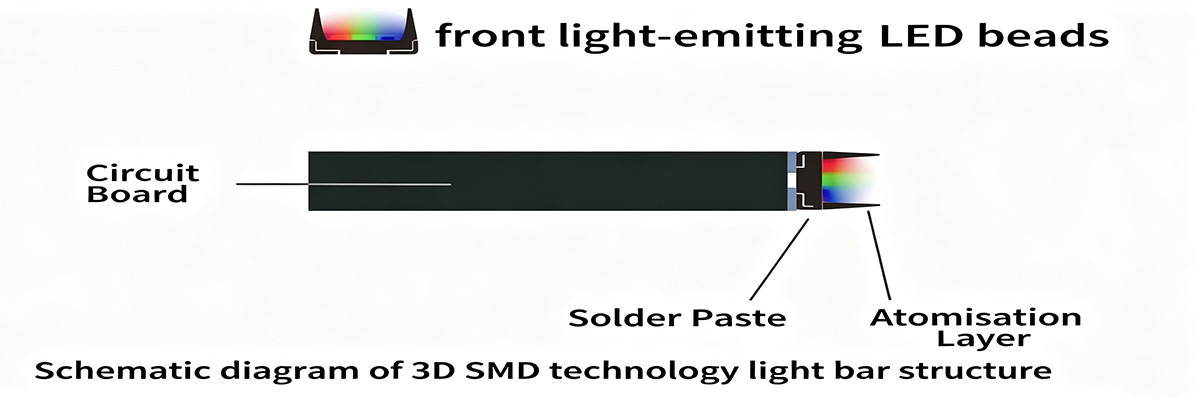
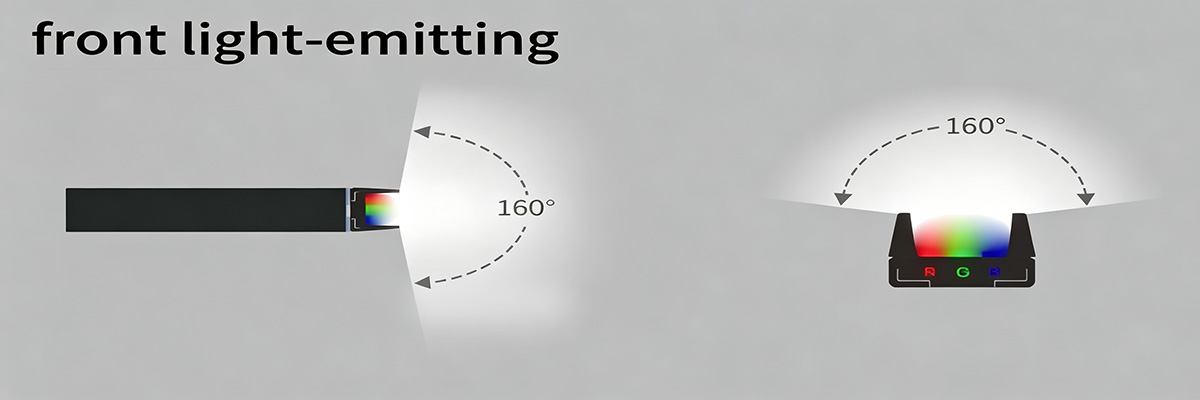
As the mainstream technology in the industry, front-emitting transparent screens adopt standard SMD front luminous technology. The light is vertically facing the audience with uniform brightness, high color restoration and stable image performance. With mature craftsmanship, low failure rate and convenient later maintenance, it is the most versatile transparent screen solution with controllable cost. Its conventional light transmittance is 40%–60%, suitable for most standard commercial scenarios.
2.2 Side-emitting Transparent Screen
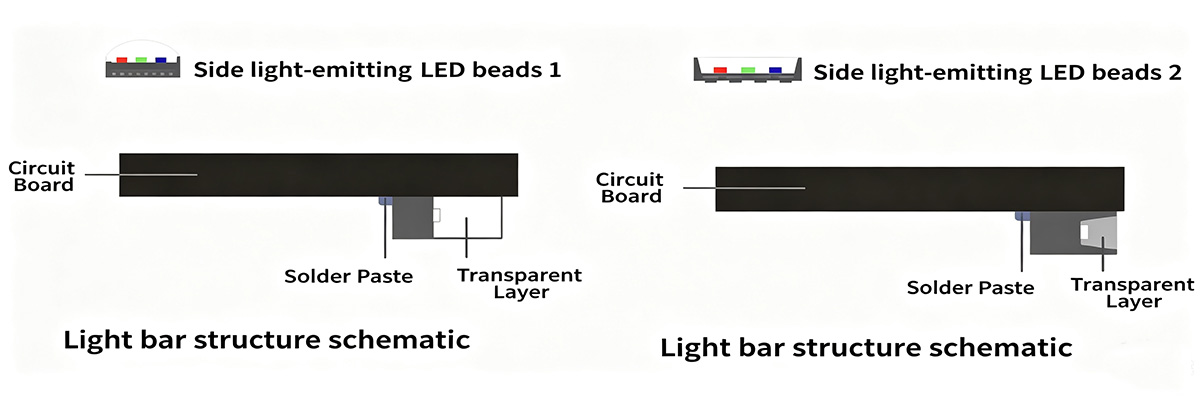
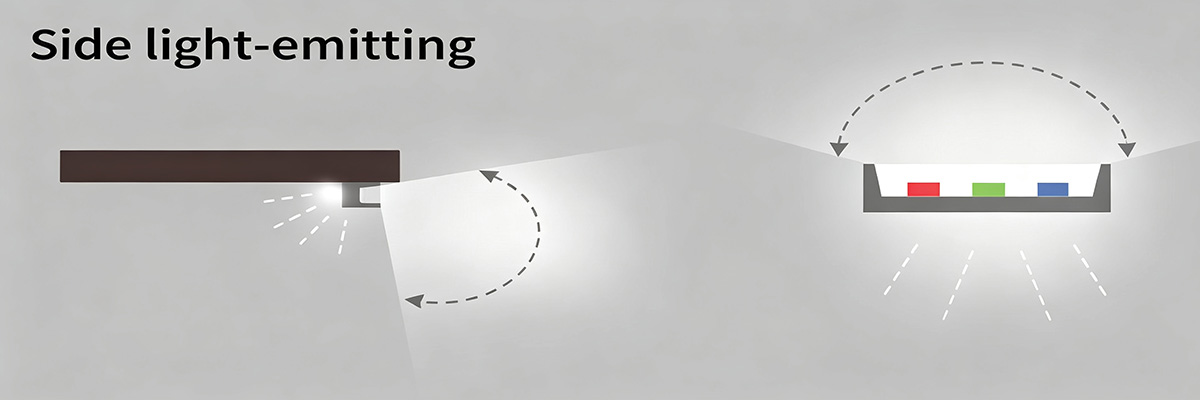
Side-emitting transparent screens adopt lateral lamp bead mounting technology, which greatly reduces frontal occlusion area and increases the light transmittance to over 70%. The screen body is thinner and lighter with better curved surface adaptability than front-emitting products. The minor visual angle deviation and slight side light leakage require higher production technology, making it targeted for high-transparency and special-shaped scenarios.
3. Classification by Usage Environment
3.1 Indoor LED Transparent Screen
Indoor transparent screens have no waterproof and dustproof design, with brightness adjusted for indoor lighting (2000–3500cd/㎡). They deliver delicate and soft color performance, including hard strip transparent screen, film screens, crystal film screens and indoor photoelectric glass screens. Featured with light weight, high appearance and high-definition display, they are applied to enclosed indoor spaces without wind, rain or strong sunlight exposure.
3.2 Semi-outdoor LED Transparent Screen
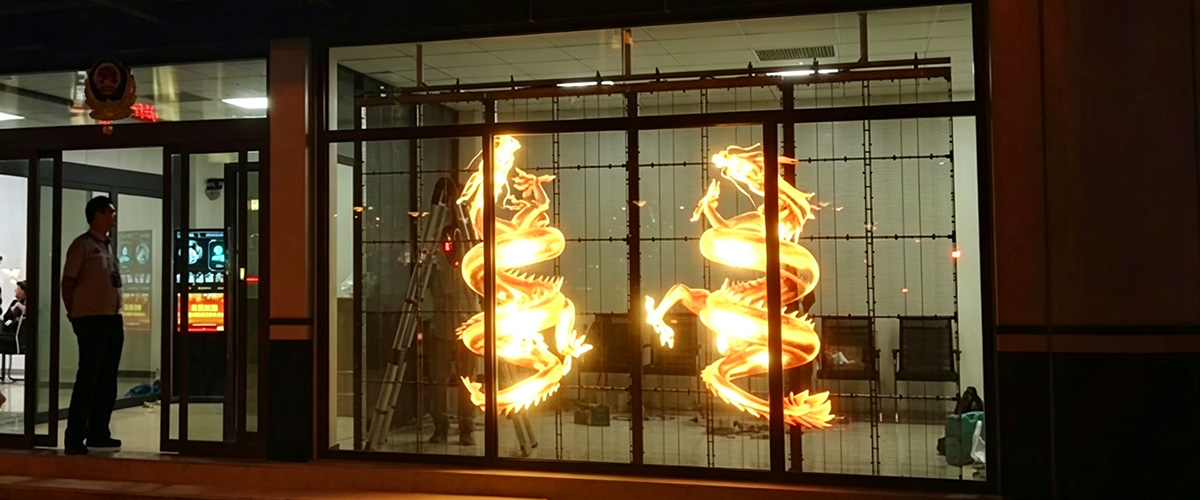
Semi-outdoor transparent screens are equipped with basic moisture-proof, dust-proof and anti-glare functions, resisting slight rain and dust erosion. With higher brightness than indoor screens, they adapt to semi-open spaces such as street store windows, semi-open shopping mall corridors and canopy inner sides.
3.3 Outdoor LED Transparent Screen
Mainly represented by LED grid screens, outdoor transparent screens reach IP65 or higher waterproof and dustproof level. They undergo professional anti-aging, high and low temperature resistance and wind resistance treatment, stably adapting to harsh outdoor environments such as strong sunlight, rain, wind and severe temperature changes. With high brightness and strong stability, they are specially designed for building exterior walls, outdoor advertising and large-scale lighting projects.
4. Core Selection Guide
1. Large outdoor curtain wall and lighting projects: Choose LED grid screen for high cost performance and durable performance.
2. Standard indoor windows, exhibition halls and partitions: Choose hard strip transparent screen for balanced image quality and practicability.
3. Glass non-destructive installation and lightweight renovation: Choose LED film screen for easy installation and zero glass damage.
4. Special-shaped curved and high-end creative scenarios: Choose crystal film screen for ultra-high permeability and premium visual effect.
5. Integrated high-end decoration glass scenarios: Customize photoelectric glass screen for integrated beauty and high safety.
FAQs
Q1: Which LED transparent screen has the highest light transmittance?
The crystal film screen (jelly screen) has the highest light transmittance of 80%–95% with an excellent invisible effect after power off. Followed by holographic mesh screens and LED film screens. Conventional rigid ice screens have relatively lower transmittance, suitable for standard commercial scenarios with moderate permeability requirements.
Q2: Which transparent screen is best for outdoor lighting projects?
The LED grid screen is the first choice for outdoor projects. It supports IP65 waterproof and dustproof performance, strong wind resistance and extreme temperature resistance. With ultra-low wind resistance, it is the mainstream solution for large-area building curtain walls and sky curtain lighting projects.
Q3: How to choose between front-emitting and side-emitting transparent screens?
Choose front-emitting transparent screens for stable image quality, cost effectiveness and easy maintenance, ideal for most commercial scenarios. Choose side-emitting transparent screens for higher light transmittance, thinner body and curved installation, perfect for high-end special-shaped glass curtain walls.
Q4: What are the core differences between LED film screen and crystal film screen?
LED film screens focus on convenient adhesive installation and cost performance, only supporting slight bending for flat glass. Crystal film screens support large-radian curling and stronger special-shaped adaptability, with better light transmission and invisible effect for high-end creative scenarios at a relatively higher cost.
Q5: What are the applicable scenarios and disadvantages of photoelectric glass screens?
Photoelectric glass screens feature integrated molding, explosion-proof safety and high-end appearance, suitable for offices, elevators and high-end hotel glass decoration. The main disadvantages are long customization cycle, non-detachable structure and higher later maintenance cost than ordinary transparent screens.

Comments