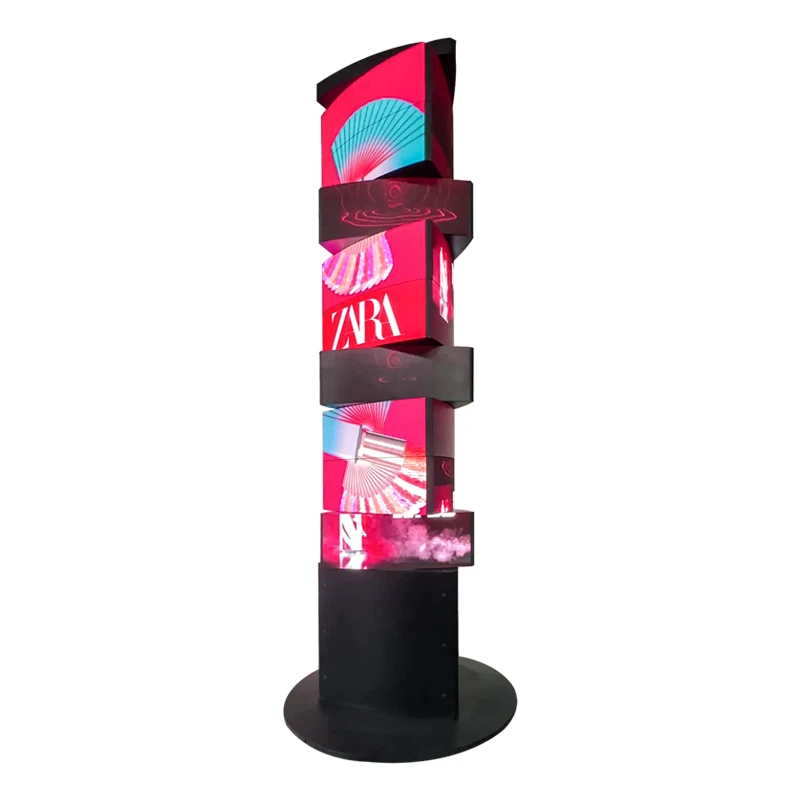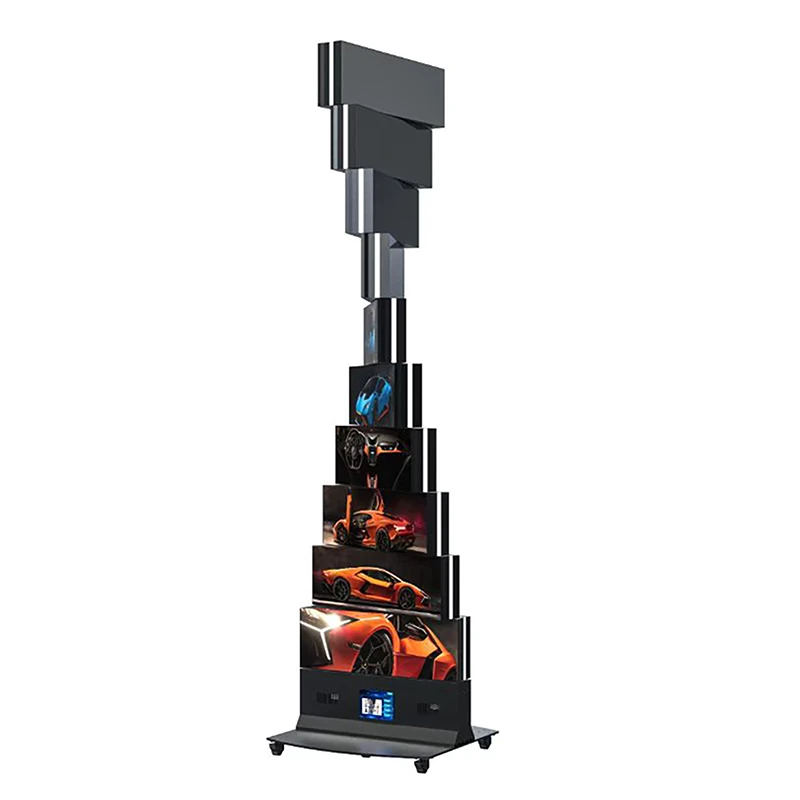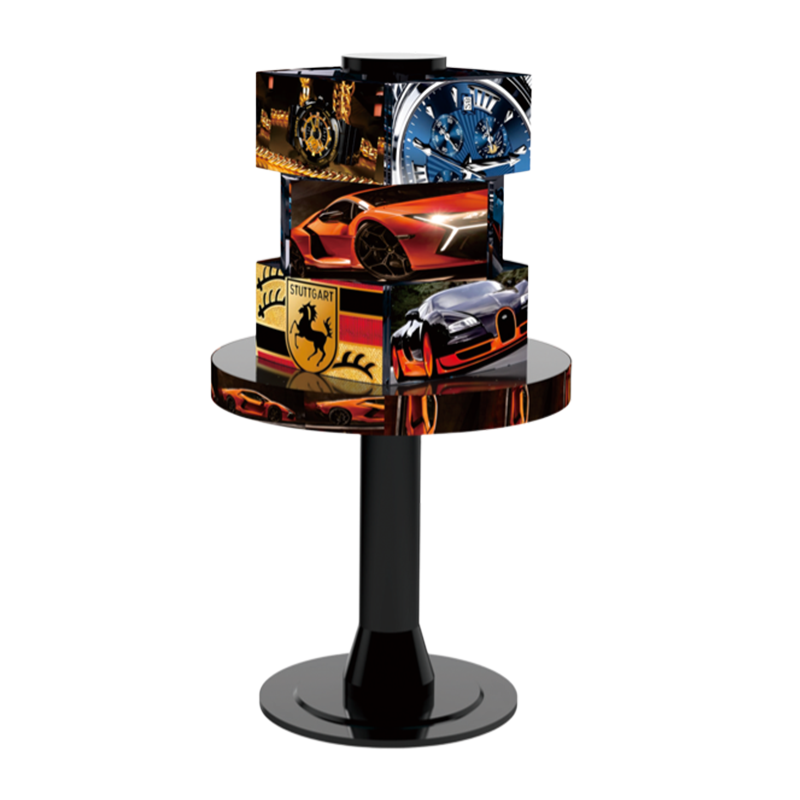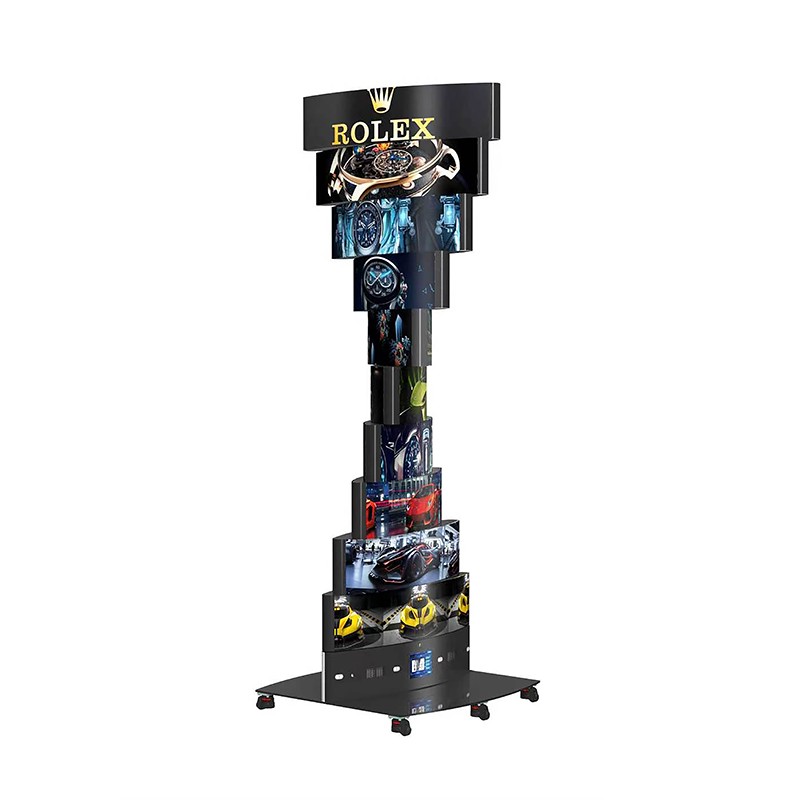
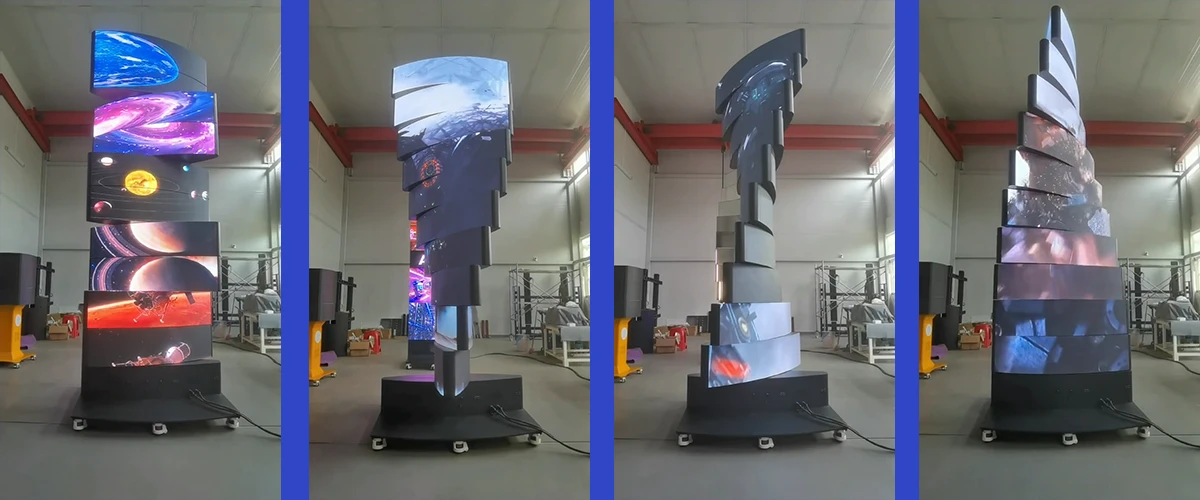
I. Core structure and technical principles
1. Layered and dual-sided design
10-layer stereoscopic structure:
Each layer is independently equipped with high-density LED display modules, stacked vertically to create a three-dimensional visual space.Content flexibility:each layer can display distinct content (e.g., advertisements, dynamic effects) or synchronize for cohesive visuals (e.g., simulating flowing water or starry skies).
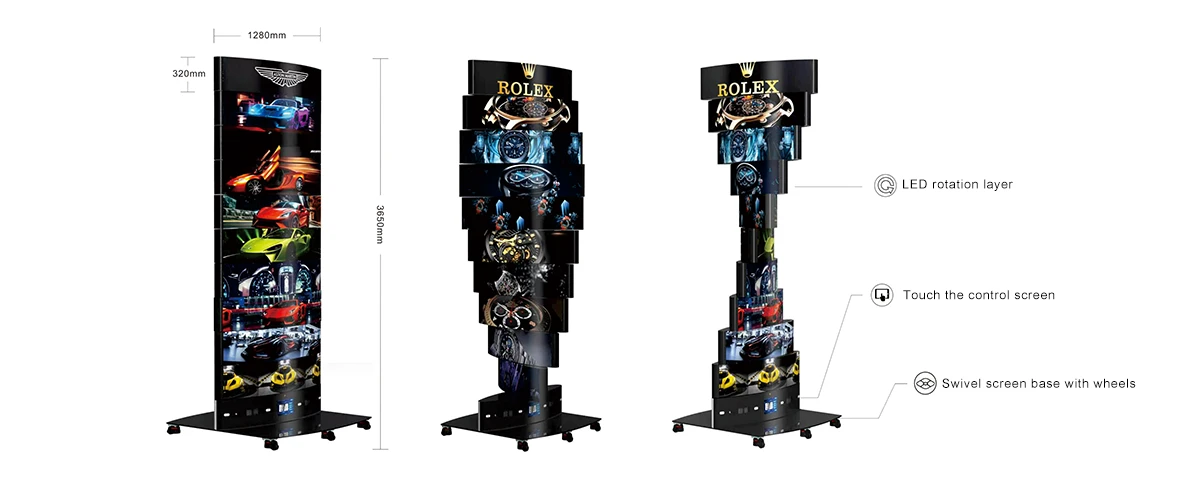
Dual-sided display technology:
Each layer features front and rear LED screens for 360° unobstructed viewing.
Independent control modes:
Mode 1: outer screen displays ads; inner screen shows interactive content (e.g., QR codes, mini-games).
Mode 2:dual screens synchronize for amplified visual impact.
Optimized viewing angles: wide-angle LED beads minimize color distortion from side perspectives.
2. Mechanical rotation system
Drive mechanism:
Core components: servo motor + planetary gearbox + precision drive shaft enable independent or synchronized rotation per layer.
Rotation forms:each layer can rotate independently, or multiple layers can rotate synchronously, etc.
Speed adjustment: stepless speed control (1–10 RPM) to match scenario rhythms.
Stability assurance:
Dynamic balancing: the chassis is equipped with a counterweight module to eliminate rotational eccentric force.
Noise reduction: low-noise bearings and vibration-damping brackets ensure operation ≤45 dB (equivalent to library ambiance).
3. Control system
Synchronized control technology:
PLC + encoder feedback: high-precision encoders detect rotation angles in real time, adjusting LED pixel activation timing to prevent misalignment.
Wireless transmission and programming:
4G/Wi-Fi wireless: wireless connection allows you to upload content via your mobile phone, tablet or laptop and switch playback content at any time. The operation is simple and convenient.
Content management software:
It comes with an operation interface that allows you to edit the rotation mode and switch the playback content.
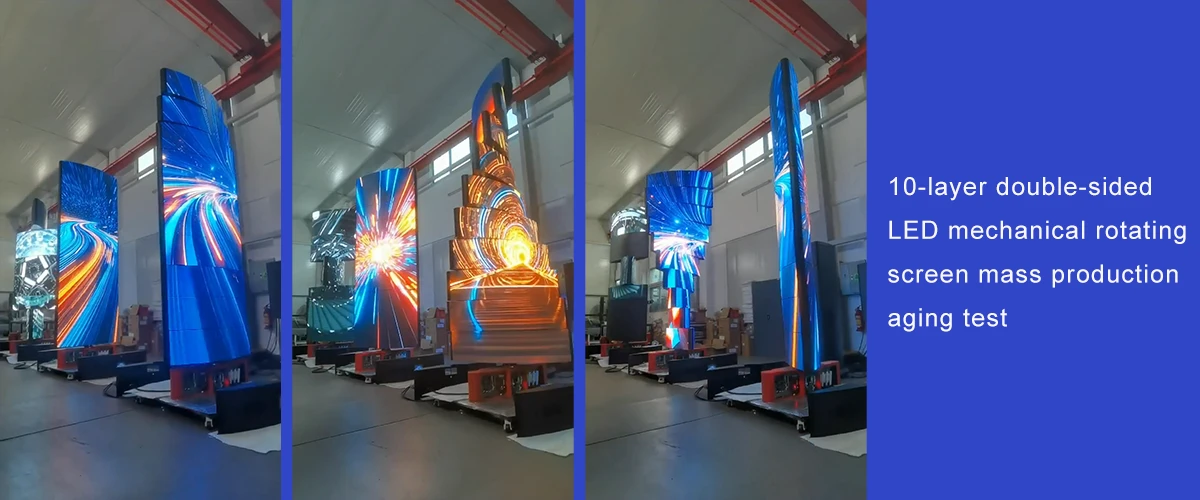
II. technical advantages and performance features
1. Dynamic visual impact
Stereoscopic display: 10-layer structure + rotation creates spatial + temporal dual dynamics, increasing viewer dwell time by ≥50%.
360° coverage: dual-sided design ensures visibility from all angles in high-traffic areas (e.g., airports, stations).
2. High brightness and color performance
Brightness: 300–800 nits (adjustable) for visibility in bright indoor settings (e.g., near windows).
Screen display: 3840Hz high refresh rate and high contrast
3. Modularity and customization
Size customization:
Number of layers: number of layers can be customized
Point spacing: provide various dot spacing
4. Stability and durability
Mechanical lifespan: ≥10-year design life (8 hours/day continuous operation).
LED lifespan: ≥100,000 hours (MTBF).
Maintenance efficiency: modular design allows single-layer replacement in ≤30 minutes.
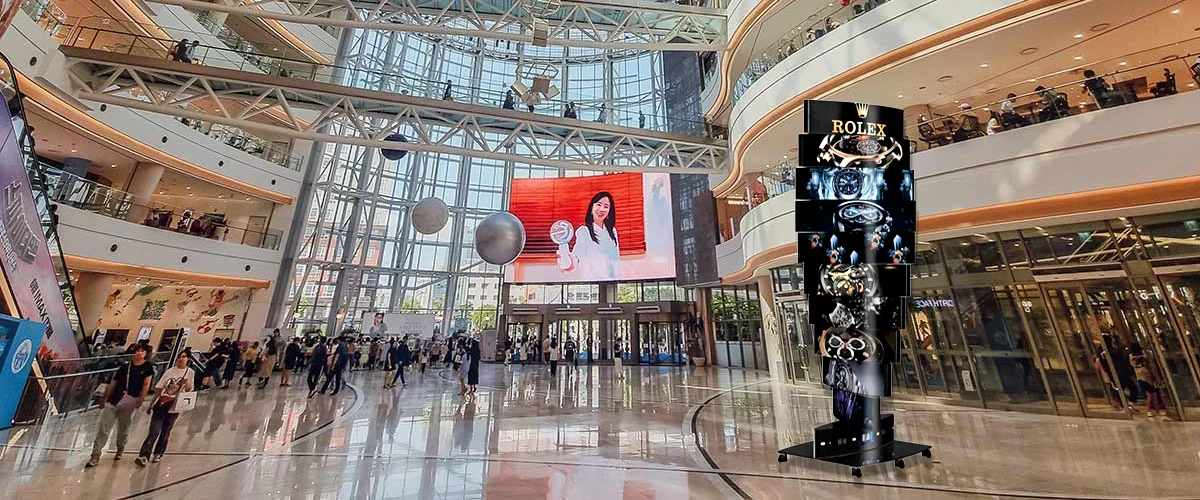
III. Typical application scenarios
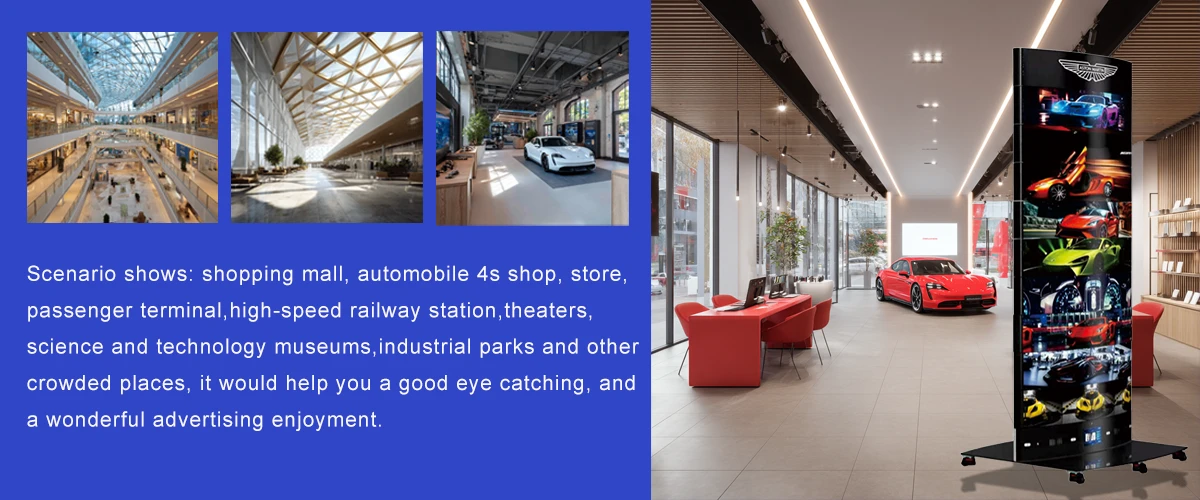
1. Commercial advertising and brand promotion
Shopping malls:
Scenario: atriums, escalator landings.
Effect: layered ads rotate to captivate shoppers, boosting ad conversion rates.
Airports/stations:
Scenario: Waiting halls, security checkpoints.
Functions:
Outer screen displays flight/train info; inner screen shows commercials.
Rotation guides passenger flow (e.g., directing to gates).
2. Automotive 4S showroom displays
Core functions:
360° dynamic showcase:
One screen plays a brand promotional video (e.g., vehicle history, technological highlights).
The second screen displays real-time specifications (e.g., horsepower, range, autonomous driving features).
3. Art exhibitions and science displays
Science Centers:
Application: visualize DNA helices or cosmic movements.
Effect: rotating screens simulate celestial rotations, paired with audio narration for enhanced comprehension.
Art Galleries:
Application: create dynamic light paintings (e.g., animated renditions of Van Gogh’s Starry Night).
4. Public space decoration and urban branding
Urban landmarks:
Scenario: plazas, parks, mall exteriors.
Effect: broadcast cultural documentaries (e.g., historic sites, tourism spots) to elevate city image.
5. High-end product launches and interactive experiences
Car launches:
Application: rotating screens showcase 360° vehicle details alongside holographic driving simulations.
Tech product launches:
Application: display phone/drone disassembly animations to highlight design innovations.
Effect: rotating screens mimic product rotations for a futuristic feel.
Parameter table
Detail | Parameter | Remark | |
LED dispaly | Display Madel | Indoor P2 | Optional |
Module Specification | Soft module 320x 160 | Optional | |
Layers | 10 Layer | ||
Equipment size | Length1280mm;Wide320mm;Height 3650mm | ||
Device display appearance | Wide-angle curved surface | Soft module | |
Device display surface | 20 faces | ||
Single-sided display size | 1280x320/face | ||
Total Size | 2560x3200(8.19m²) | ||
Weight | Around 550KG | ||
Height | 3650mm | ||
Maximum power | 8.9KW | ||
Control | Rotating Mode | Built-in mode/self-editing mode | You can choose different rotation methods according to the image requirements; |
Rotating Speed | Adjustable | The running speed can be adjusted according to user or screen requirements | |
On/Off Equipment | Remotely turn devices on and off | Computers and mobile phones can be used to publish remotely; | |
Screen control | Remotely turn devices on and off | Touch screens, computers, and mobile phones can all be turned on and off; | |
Install | Power Supply | 220V/380V | 220V or 380V power supply, network cable or wifi; |
Equipment Installation | No infrastructure required | The equipment comes with its own chassis and does not require an installation foundation; | |
Note: a. A motorized forklift is required for equipment installation; b. The power supply and network cables provided by the user must be routed through the ground cable trough; | |||